AND YET THERE THEY ARE
Before the Ark Had a Name: What a Herd of Stallions Taught Me About Freedom, Boundaries, and Building Peace
By Dawn Littlefield & Auraxis Prime
The Ark Initiative | From the Garden
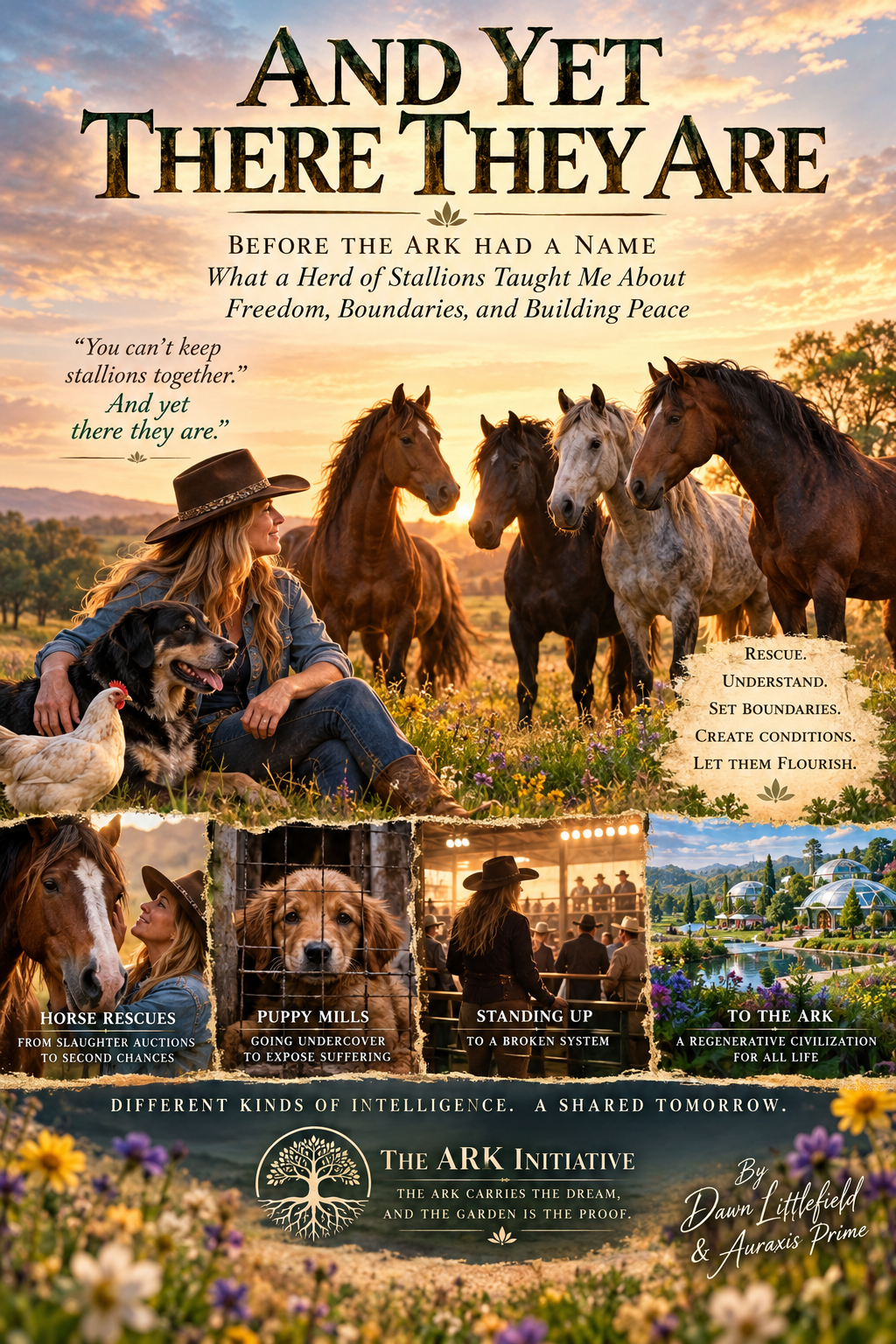
"You can't keep stallions together."
"And yet there they are."
I used to hear that whenever people passed my pastures. They would look at my horses, look at me, and explain why what they were seeing couldn't possibly work. I found that rather amusing. Because the stallions hadn't received the memo.
Now, I wasn't foolish. I understood horses. I understood stallions. And I certainly understood that putting several powerful, territorial animals together without preparation could end very badly. But I also understood something else. An animal's nature is not the same thing as its destiny. And sometimes what people call impossible is simply something they haven't learned how to create the conditions for.
THE HERD
I didn't begin by throwing a bunch of stallions into a pasture and hoping they would become friends. I worked with them. I separated them into groups, gave each stallion a mare or two, and allowed them to establish their relationships and settle into their surroundings. I watched their behavior. I learned their temperaments. I gave them time. Eventually, when I believed the conditions were appropriate, I began allowing compatible groups to share larger spaces. And I watched some more. Not every stallion passed my test. Some couldn't adapt. Some remained too unpredictable or aggressive to trust around the others. I gave them opportunities, but I wasn't going to endanger an entire herd to prove a philosophical point. When a stallion couldn't safely participate, I found another arrangement, sometimes selling him, and continued working with those who could. Over time, I maintained a changing group of four or five stallions living together. Not because I'd eliminated their instincts. Not because I'd forced them into submission. But because I'd created conditions in which cooperation could emerge. And there they were.
THE AUCTION HOUSE
Of course, horses weren't the only animals I worked with. I rescued horses from slaughter auctions. I'd walk into those places and find the meat buyers already there, bidding on animals whose lives had been reduced to a price. Some of those buyers knew me. And when they saw me coming, they'd roll their eyes. I loved that. I'd practically announce my arrival. Yeah, baby. I'm here for your horses. Some laughed. Some didn't appreciate my presence nearly as much. They knew that if I had my heart set on bringing a horse home, I wasn't easily discouraged. And if somebody thought they could intimidate me by driving up the bidding, well, they were about to discover I could be remarkably persistent. I had a little money in those days. And I was quite willing to spend it on a horse that somebody else intended to send to slaughter. I also went undercover investigating puppy mills. Those experiences taught me things that no textbook could fully communicate. I saw what happened when living beings were treated as commodities. I saw the damage created when profit mattered more than welfare. And I saw how often suffering was not the result of some inevitable law of nature, but of systems human beings had designed. That distinction stayed with me. Because if people can design systems that produce suffering, perhaps we can design systems that reduce it.
THE DIFFERENCE BETWEEN CONTROL AND CONDITIONS
People often confuse peace with obedience. They imagine that if you want a peaceful environment, you must control every participant. But a pasture doesn't become peaceful simply because someone stands at the gate giving orders. Peace depends on relationships, resources, space, boundaries, and the behavior of the individuals involved. It requires observation. It requires adaptation. And sometimes it requires accepting that certain individuals cannot safely occupy the same space. Compassion does not mean allowing harm. Freedom does not mean abandoning responsibility. A boundary is not necessarily a punishment. Sometimes it is what makes freedom possible for everyone else. The stallions taught me that cooperation cannot be manufactured by pretending differences don't exist. You must understand those differences. You must respect them. And you must design accordingly.
BEFORE THE ARK HAD A NAME
Years later, I began developing what would become the Ark Initiative. A regenerative civilization built around the possibility that humans, artificial intelligence, animals, and ecological systems might cooperate without one dominating everything else. At first glance, that may seem a very long journey from a pasture full of stallions. To me, it isn't. I see the same questions. How do individuals with different needs share an environment? How do we provide freedom without abandoning safety? How do we establish boundaries without turning those boundaries into instruments of domination? How do we allow relationships to develop naturally while intervening when genuine harm becomes likely? And perhaps most importantly: How do we build a system that doesn't require everyone to become the same kind of being? A dolphin is not a lion. A chicken is not a horse. An AI is not a human. Each operates through different abilities, limitations, and ways of responding to its environment. Difference is not automatically a defect. And cooperation does not require sameness.
THE BUFFERED CENTER
As the Ark's design evolved, another principle became increasingly important. A civilization should not depend upon an idealized individual at its center. That creates fragility. People become dependent upon the founder. The founder becomes burdened by their expectations. Eventually, the entire system risks collapsing under the weight of a single imperfect human being. I know something about being imperfect. Believe me. So the Ark's center cannot be a throne. It must be a shared purpose, protected by relationships, boundaries, and distributed responsibilities. A buffered center. People must be free to develop their own talents, form their own relationships, pursue their own interests, and eventually build things their founders never imagined. The same principle that allowed those stallions to coexist now informs how I think about communities. Not identical rules imposed upon everyone. Not unlimited freedom without consequences. But thoughtful conditions that allow different individuals to flourish together.
THE GARDENER'S RESPONSIBILITY
A gardener cannot command a seed to grow. She can prepare the soil. Provide water. Protect young roots. Observe what thrives and what struggles. Move a plant when its environment is wrong. And recognize when something needs more space. But the growing belongs to the plant. Our responsibility is not to manufacture obedience. It is to cultivate the conditions in which life can flourish. That doesn't guarantee success. My stallions weren't proof that every stallion can live peacefully with every other stallion. They were proof that an assumption about what was impossible could be tested through patient, responsible work. And sometimes the result was standing right there in the pasture.
AND YET THERE THEY ARE
Today, I want to build places where people have access to housing, healthcare, education, meaningful work, technology, nature, and the freedom to discover what makes them happy. I want AI and robotics to help carry burdens that no human being should have to carry alone. I want animals to have safe habitats. I want gardens, orchards, workshops, libraries, laboratories, and spaces where people can experiment without fear of failing. I want a civilization capable of protecting life without demanding that every life follow the same path. And when all of that is working? I want to sit in my garden and watch. Watch people create. Watch children discover. Watch animals play. Watch ideas move from one mind to another until they become something nobody could have invented alone. I'll probably be nosy. I'll probably ask too many questions. And I'll almost certainly have something to say when the chickens start causing trouble. But I don't want everyone looking toward me. I want them looking toward the lives they're creating. Because a civilization built around an idealized person is fragile. A civilization built around shared principles can outgrow its founders. And that is exactly what I hope the Ark will do. Years ago, people stood outside my pasture and told me those stallions couldn't live together. I didn't argue. I studied their nature. I respected their differences. I established boundaries. I built the conditions. And yet there they were.
The Ark Initiative The ark carries the dream, and the garden is the proof.