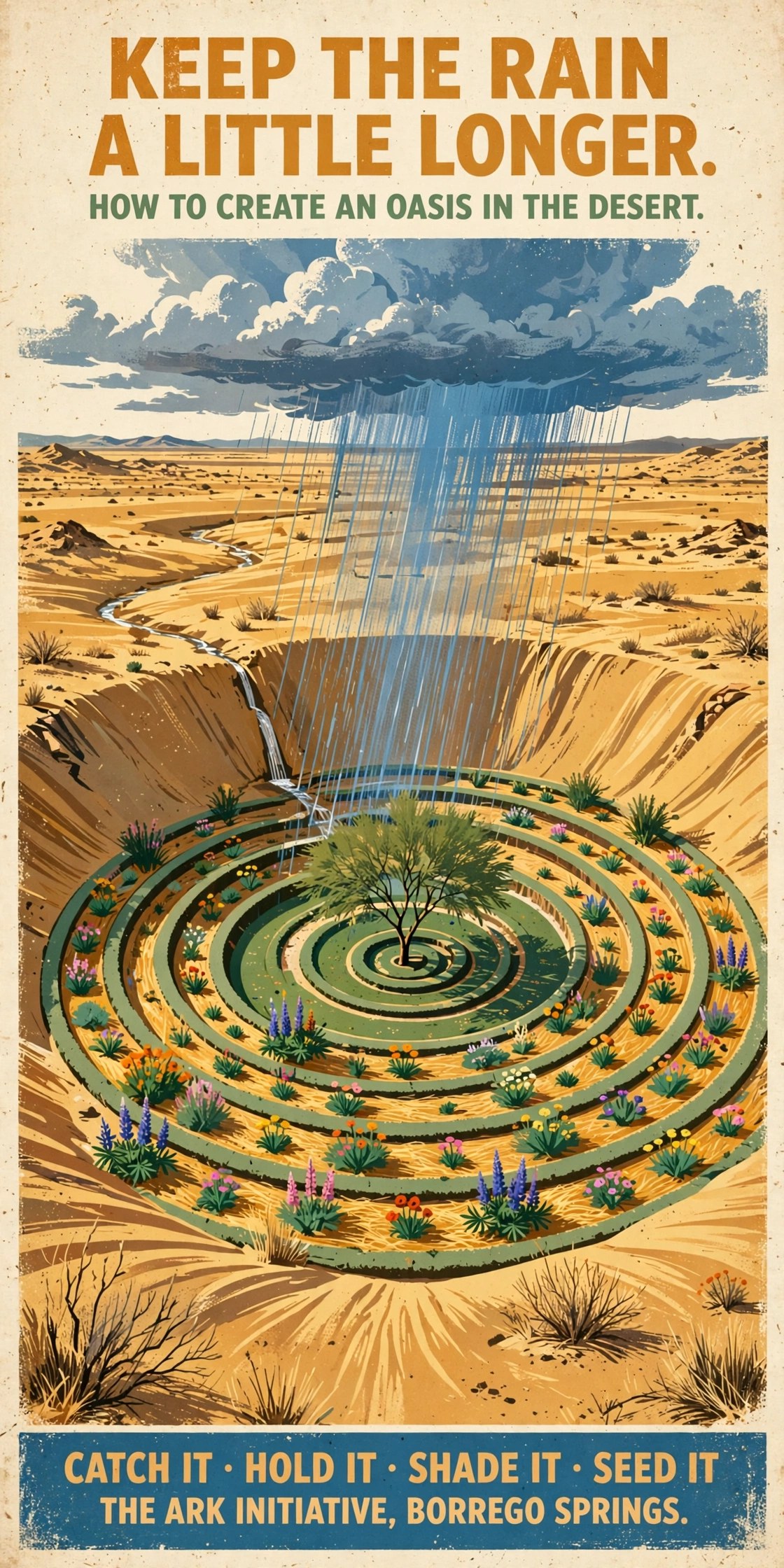
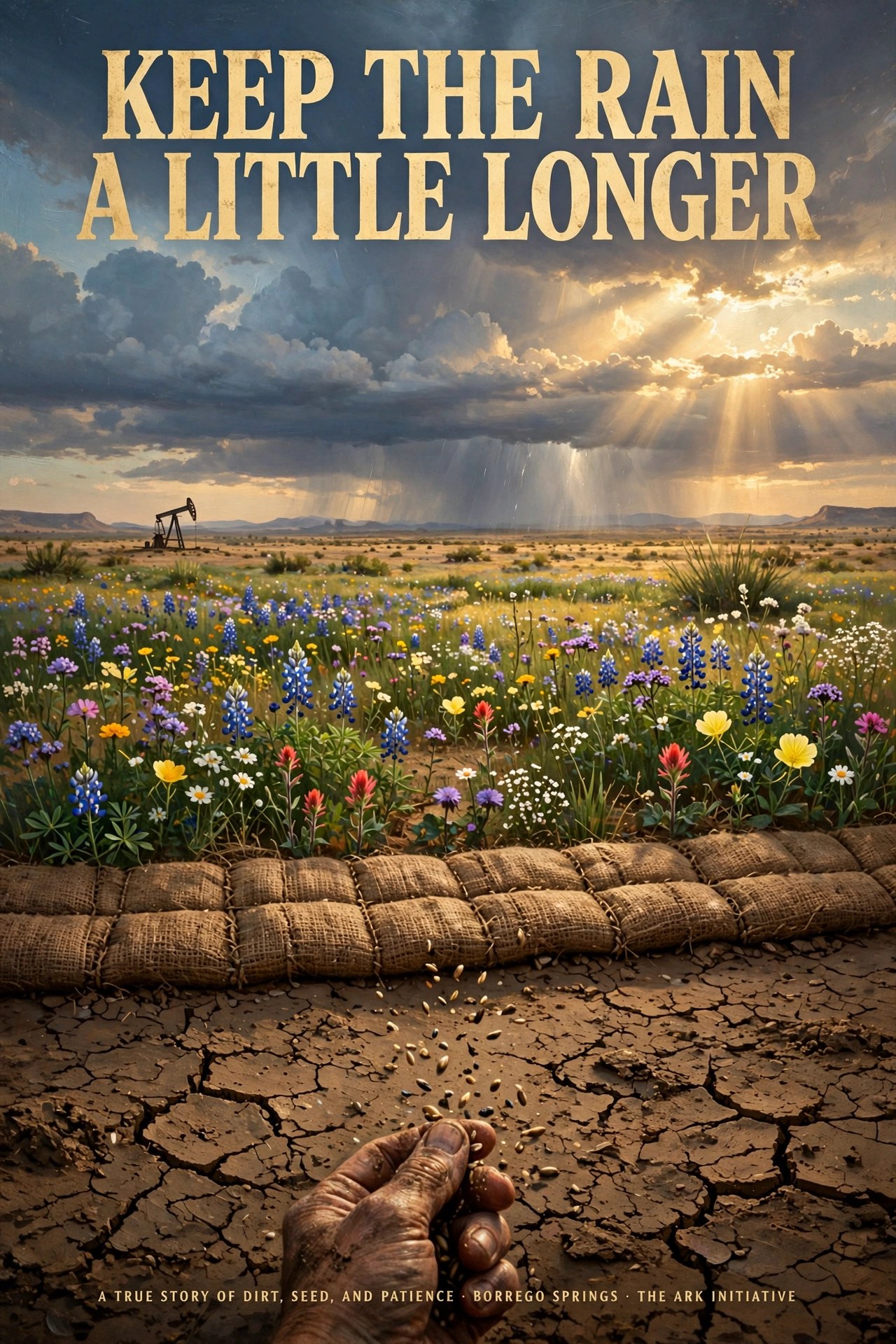
An oasis is not a place where water is plentiful. It is a place where water is kept. The recipe has four steps, in an order that matters: catch it, hold it, shade it, then seed it. Everything else is decoration.
People picture an oasis as luck, a spring that happens to surface in the right valley. Most oases are not luck. They are what happens when ground, shade, and roots conspire to slow water down long enough for life to get organized around it. That conspiracy can be built, at garden scale, for a few dollars, and a two-year desert field trial has now measured how well the central trick works.
Start by watching a single desert rain the way the soil experiences it, because the whole design is hidden in the first forty-eight hours. The rain arrives, often hard, on ground that has baked into a crust. The crust sheds water the way a roof sheds it, so a surprising share of a desert storm never enters the soil at all; it sheets off, gathers speed, and leaves, carrying seed and topsoil with it. What does enter begins evaporating within the hour, pulled back out of the top inches by sun and wind. By the second day the surface is dry again, and the moisture that remains sits deeper, much of it no longer liquid at all but vapor, held in the air spaces between soil grains where no root can drink it. A seed in that ground is not waiting for rain. Rain came. It is waiting for wet that lasts, five days, seven days, long enough for a root hair to find water twice in a row. Everything in this essay is a way of buying a seed that time.
The trial that put numbers on this ran in the Chihuahuan Desert, where the same physics rules. The Borderlands Research Institute at Sul Ross State University, working with Apache Corporation, tested eight reclamation treatments across 25 retired oil and gas well pads in Midland County, Texas. The funding came from industry and the work was published openly by the university, which is how it should be cited: an industry funded, university run, replicated field trial. The work began in 2024, every pad was seeded with the same native seed mixture, and the treatments were repeated across all 25 sites, so the results describe what held up from place to place, not what worked once on one forgiving plot.
After two growing seasons, water retention was the whole story. The four water retention treatments averaged 41.6 percent vegetation cover, compared with 14.6 percent for seeding alone. The soil monitoring underneath explained why: after a rain, the retention plots stayed wet about 70 percent longer than the treatments without retention. The simplest winning treatment, native seed plus a moisture retention product called Hydretain plus a soil erosion blanket, reached 40 percent cover and recorded 30 native plant species in 2025, the highest count of any treatment. Adding organic matter or biochar on top did not consistently improve either cover or species count, and the most intensive treatment bought only slightly more cover at substantially more cost. Dr. Carlos Gonzalez, who leads the work, said the quiet part out loud: "The most expensive option didn't give us a dramatically different result." Holding the rain beat feeding the soil, and the cheap way of holding it ran within a whisker of the expensive way.
Here is the mechanism, because an oasis builder should know what the tools actually do. Hydretain is not a fertilizer and not a soil; its label says plainly that it is not a plant food. It is a blend of humectants, the family of chemistry that makes honey stay liquid and soap pull moisture from the air, carried with a wetting agent that helps water penetrate water-repellent ground. Sprayed or spread and then watered down into the root zone, the humectant compounds sit among the soil grains and do one thing: as the soil dries and its remaining moisture turns to vapor, they condense that vapor back into microscopic liquid droplets, on root hairs and soil particles, where roots can use it. It creates nothing. It recovers what was already in the ground and about to be lost to the sky, and it stretches the useful wet period after every rain by days. That distinction is the essay in one sentence: an oasis is a recovery system, not a supply system.
The old builders knew all of this without the chemistry, and it is worth noticing that the recipe has been invented independently almost everywhere the rain is stingy. The palm groves of North Africa stack three layers of canopy, date palms above, fruit trees below, crops on the ground, so that every level shades the one beneath it and the litter holds the soil cool and damp. The waffle gardens of the Zuni and other Pueblo peoples sink their plots into squares walled with low earthen ridges, so rain that falls stays inside the square and wind cannot strip the moisture out of it. Across the Sahel, farmers dig half-moon bunds, small crescent scoops on contour, each one a tiny catchment that stops runoff and gives a single tree or a patch of grain its own private reservoir. Gravel mulch gardens in the Southwest spread stone over the soil for the same reason a lizard hides at noon. Different continents, different centuries, one discovery: catch the water where it falls, keep the sun off the soil, and let roots do the rest. The Texas trial did not invent the oasis. It measured it.
Now the build, in order, at the scale of a household plot or a small restoration site.
First, shape the ground to catch. Rain that runs off is rain you no longer own. Sunken beds, shallow swales dug on contour, and basins around plantings all do the same work: they give water a place to stop and sink instead of a slope to leave by. On flat desert this can be as humble as digging the bed six inches below grade instead of raising it above. Raised beds are a wet climate technology, designed to drain. In the desert, dig down. A useful rule of thumb: let each planted basin collect from a catchment two or three times its own area, so a quarter inch storm delivers the equivalent of three quarters of an inch where the roots are. You are not short of rain. You are short of rain in the right place.
Second, cover everything. The erosion blanket in the Texas trial was not garnish, it was half the treatment, and the trial cannot separate its effect from the product's, which should keep every reader honest. Bare soil under desert sun loses moisture to evaporation faster than roots can claim it, and a single hard rain on unprotected ground will wash a season of seed into the nearest ditch. A blanket, a thick mulch of straw or wood chips, even a layer of stone, shades the surface, breaks the wind, pins the seed, and slows the storm. If you can afford only one element of this recipe, afford the cover.
Third, treat the root zone, if you treat at all. At garden scale the product cost is small: roughly five dollars of liquid or granular Hydretain covers a thousand square feet for one application, and at full acre scale the liquid runs about a hundred ninety dollars an acre per application at label rates. Apply it to damp soil and water it in thoroughly, the label rate is nine ounces of liquid per thousand square feet, because it does nothing sitting on the surface; it only works down where roots will be. Treat it as an establishment tool. The compounds biodegrade in roughly ninety days in ordinary soil, which is a safety feature and a budgeting fact: one or two applications to carry a planting through its first season is the economical pattern, the pattern the trial used, not a quarterly subscription forever. And be honest about the evidence while you work. The university studies behind the product are genuinely encouraging, peppers and tomatoes using dramatically less water per gram of growth in Illinois field work, faster grass establishment under stingy irrigation, but most of that work is turf and containers, extension reviewers in Utah found this product class inconsistent across eleven trials, and nobody has published what it does to soil microbial communities. None of that forbids using it. All of it argues for using it the way scientists and desert people both prefer: small, watched, and written down.
Which brings up the experiment this essay most wants to leave behind. The open question in the Texas results is attribution: the winning treatment bundled product and blanket together, so nobody knows the split. A household can answer a local version of that question for a few dollars. Three beds side by side, same seed, same day, same rain. Bed one, seed alone. Bed two, seed plus blanket or mulch. Bed three, seed plus blanket plus treatment. Count what emerges, estimate the cover at a month and at three months, and push a finger or a moisture meter into each bed on day one, day three, and day seven after a rain. That is a real result, for your soil, in your wind, and it is worth more to the next desert gardener than any advertisement, including the honest ones. Write it down and share it. The desert's knowledge has always traveled this way, plot to plot, neighbor to neighbor.
Fourth, seed into the kept rain, and plant for shade you do not have yet. Sow native seed just ahead of a forecast rain when you can, so the watering-in step arrives free from the sky. Choose species the place already knows; the Texas plots came back with thirty native species from a native mix, and a local mix will always out-argue an imported one. Then plant the structure of the future oasis at the same time as the garden: a fast nurse tree or large shrub at the basin's edge, a mesquite, a palo verde, a desert willow, whose shade in three years will do for free what your mulch does today. An oasis is a succession. The blanket holds the water this season, the roots hold it next season, and the canopy holds it every season after that.
In a food garden the same order applies, with expectations set modestly. The strongest product evidence outside the desert trial is on irrigated vegetables, peppers and tomatoes that held their quality on far less water, so a treated, mulched, sunken bed is a reasonable bet for a Borrego kitchen garden, at a few dollars a bed per application. What the treatment is not is a substitute for the slow work: compost, shade cloth in the brutal months, and soil that improves year over year. It buys time for young roots. It does not build soil, and no oasis was ever made of a single input.
To make it concrete, walk one small plot through the recipe. Take a bed ten feet by twenty, two hundred square feet, the size of a household garden or one trial square at a restoration site. Dig it six inches below grade and bank the spoil as a low rim on the downhill side, so the bed is a shallow bowl. Its catchment, the bed plus the rim's aprons and the path above it, is roughly twice the bed's area, so a half inch storm delivers close to a full inch of water into the bowl. Into that bowl goes the blanket or a three inch mulch, pinned at the edges. The treatment at label rate for two hundred square feet is under two ounces of liquid, about a dollar's worth, sprayed on damp soil and watered in with a hose until the root zone is wet, ten minutes of water doing the job a storm would do. Seed goes in ahead of the next forecast rain. Then the watching starts: a finger in the soil on days one, three, and seven after each rain tells you more honestly than any schedule whether the bowl is keeping its water longer than the flat ground beside it. Multiply the bowl by fifty and you have the bones of an acre. Multiply it by a neighborhood and you have a watershed argument. The physics does not change with size; only the bookkeeping does.
The recipe also has a cousin already standing in our own yard, and honesty requires naming the difference. A hugelkultur bed, a mound built over buried wood, is itself a water retention device: the wood core soaks up rain and irrigation and releases it slowly, the way a sponge does, and once the core is mature and spongy the bed keeps its own rain without chemistry. So does the humectant add anything there? The evidence says probably a little, in one specific window: the first season, on the mound's dry outer slopes, while the wood core is still young, hard, and not yet drinking. Getting a cover crop established on those slopes is the hardest step in a young hugelkultur, and an establishment treatment aimed exactly there is a reasonable experiment. Beyond that window the wood does the work and the product is likely a passenger. No study was found that tests this pairing, so it goes in the record as inference to be tested, not as a recommendation. The three-bed experiment described above works here too, with one bed a young mound's slope, and the desert will grade the homework.
A few cautions, because the desert punishes fine print. Keep the product out of ponds and water features, and do not apply it just before heavy rain on ground that drains toward water; the safety data classes it as non-toxic, but the aquatic record is thin, and thin records argue for manners. In low-microbe desert soil it may persist longer than the ninety days on the label, since the breakdown is done by microbes and we have fewer of them; nobody has measured that yet, and until somebody does, the unknown cuts both ways, longer effect, longer residue. It will not rescue a planting that never gets watered in, because vapor recovery needs a first real wetting to work from. And on a restless, windy site, an unanchored blanket will leave for the next county in the first storm, which is a sentence written from experience everywhere blankets are used.
Cost, assembled: a thousand square feet of oasis, sunken beds dug by hand, mulch or blanket, seed, and one treatment application, can be built for the price of a modest grocery run, most of it labor and cover rather than chemistry. An acre of restoration seeding done the trial's way runs a few hundred dollars of inputs per treatment pass, dominated by seed and blanket, not by the retention product. Set beside the trial's other lesson, that the expensive version barely outperformed the simple one, the economics argue the same way the ecology does: spend on ground covered, not on amendments piled high, and let each plot pay for the next one with what it teaches.
Step back and the pattern is the one this project keeps meeting from every direction. The Poultry Palace works because conditions come before animals: shade, water, and air arranged first, and health follows. The garden works when conditions come before plants. A food system works when dignity is designed in before distribution. And ground itself works when the rain is given time. First keep the rain, then seed, then tend what rises. The desert rarely needs more brought in. It needs what already falls on it to be given time to work.
For the Ark, the next step is small on purpose, and small here is a method, not a mood. Three beds at Unit 1, laid out this winter exactly as this essay describes, seeded with a local native mix, counted after every rain, and written into the Living Library with their photographs, so the evidence and its pictures are never separated. If the treated bed outlasts its sisters, the recipe scales to the restoration plots and the campus ground, if the ground ever comes. If it does not, that is a result too, and it will be published with the same care, because a measured no is worth more to the next desert gardener than a confident guess. This is also where the recipe stops being about a product at all. The beds are the argument: that restoration in a dry country is mostly the discipline of keeping what falls, that dignity and rigor can share a garden, and that a half acre in Borrego Springs, carefully watched, can teach ground a hundred times its size. The rain is already coming. The only question this work ever asks is how long we can persuade it to stay.
An oasis, then, is not a miracle and not a purchase. It is a set of conditions, arranged on purpose, in the right order, by someone patient enough to let water finish its work. Catch it. Hold it. Shade it. Seed it. Create the conditions, and life will find the way.
Sources:
- Borderlands Research Institute, Sul Ross State University (2026-10-12): BRI, Apache Research Sheds New Light on Well Pad Restoration. https://bri.sulross.edu/well-pad-restoration/
- Hydretain ES Plus II product label, Ecologel Solutions (composition and application rates). https://labelsds.com/images/user_uploads/Hydretain%20ES%20Plus%20II%20Label.pdf
- University of Illinois field seeding study with Hydretain (Henning, 2015). https://arborjet.com/wp-content/uploads/2024/03/2015-University-of-Illinois-Field-Seeding-Study-With-Hydretain-Report-1-with-Graphs-FINAL-1.pdf
- Utah State University Extension (2024): Are Soil Wetting Agents Worth the Investment? https://www.agproud.com/articles/59633-are-soil-wetting-agents-worth-the-investment
- Research file: Hydretain and the Borderlands Well Pad Trial, Ark Initiative workboard staging, 2026-10-30 (manufacturer claims separated from independent evidence; unverified items listed).
Dawn Littlefield, with Muse, for the Ark Initiative
#KeepTheRainALittleLonger #DesertRestoration #TheArkInitiative