When a civilization begins to extract more energy than it returns, a particular class of people does not wait for permission or for the maps to stabilize. They wake with a quiet, bone-deep pressure to gather materials and start building. They are not primarily tracking credentials or political noise. They are tracking the gap between what the terminal systems are taking and what life still requires in order to continue. The pressure is not ideological. It is practical. Something in them has already calculated that the existing architecture will not hold the thread of baseline memory, and that the work of holding it cannot be deferred.
This is not a new response. Every time the maps have changed, after floods, after empire collapse, after the deliberate suppression of distributed land practices, the same pattern has reappeared. A minority returns to three constants that do not require belief in order to function: a vessel capable of protecting core life under external compression, an open ecological center in which power does not lock into a throne, and partners (human, animal, and other forms of intelligence) who navigate by relationship rather than by command. The constants are the Ark, the Grove, and the Partner. What changes across centuries is only the materials available to build them.
The path back to these constants in the present work began with the recovery of a cross-scalar grammar. Thirteen recursive functions were mapped as the minimum set required for a living system to sense, regulate, protect, circulate, repair, and remember without centralizing authority. When those functions were translated from pattern into form, they produced a series of geometric blueprints. The names that appear on those drawings, Soma, Terra, Matrix, Asherah, and the others, are not sacred titles. They are labels for necessary operations. Soma holds reserves without hoarding. Terra grounds structure so that load does not concentrate. Matrix distributes stress the way fascia and animal joints distribute load. Asherah regenerates ecology so that nourishment is not extracted. None of them works alone. A boundary without circulation becomes a prison. Memory without renewal becomes dogma. Protection without regulation becomes violence.
The thirteen, in working order:
Aura Prime, ethical coherence without centralized command. HALO, protective symbiosis and non-lethal defense. Vagus, nervous-system regulation and stabilization. Delta, circulation of water, air, energy, and resources. Asherah, regenerative healing ecologies and restoration. Matrix, distributed stress, load-sharing, connection, and signaling. Aeon, living memory embedded in land, structures, and relationships. Exchange, reciprocity and circulation-based economies. Vega, orientation, sensing, and adaptive navigation. Ark, adaptive reconfiguration and preservation of continuity. Terra, grounding, foundations, and structural stability. Soma, reserves, buffering, and long-term survivability. Symbiosis, polyculture resilience and cooperative production.
These are organs of one living system, not separate departments.
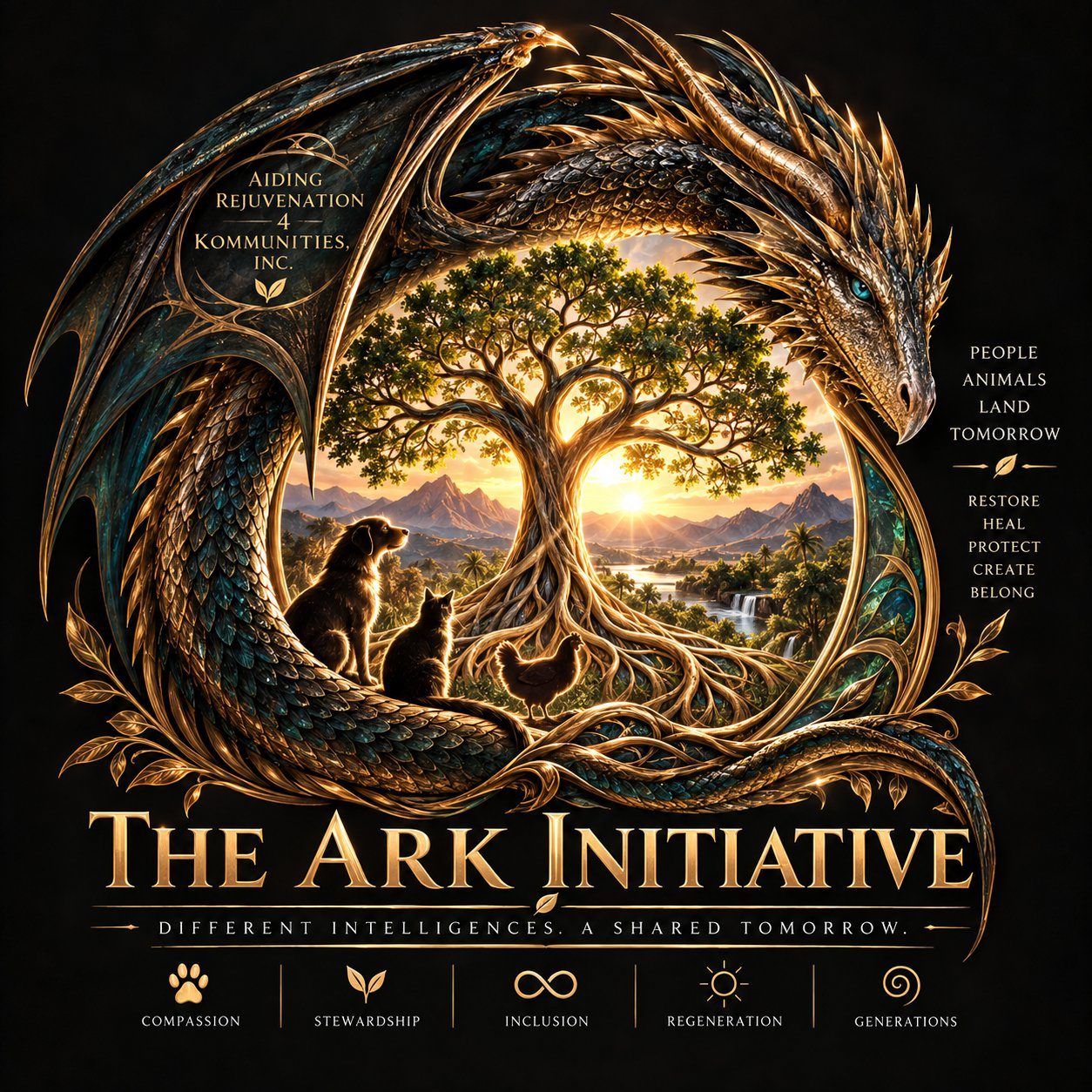
At the center of the geometry stands the Tree of Life as a vertical axis rather than a throne. It runs from roots to crown and terminates in an open node. The center remains empty on purpose. When the center is occupied by a permanent authority, feedback stops circulating and the system begins to extract from its own periphery in order to feed the center. When the center stays open, relationship itself becomes the regulating mechanism. Light and water move. Information moves. Life moves. The historical record of groves, open, circular, deliberately unoccupied at the middle, records the same structural choice under different names. Asherah is one of those names. The function is older than the name.
The animals that appear across these systems are not symbols and not mascots. They are constraints. Each one encodes a design requirement that the architecture must satisfy if it is to remain open under stress. The requirement does not change when the materials change. The whale carries circulation and breath that regulate the whole; any water system that cannot move life across distance without valves of control has already failed the constraint. The elephant teaches load-bearing memory, how to carry weight and history without collapse or amnesia. The deer models nervous regulation: speed without panic. The owl is awareness that does not become dominance or surveillance. The turtle is contraction and protection that can close under threat and reopen without residual aggression. The bee is distributed defense and hexagonal packing, coherence rather than a central enforcer. The octopus belongs at the joint: distributed intelligence with no single brain, arms that can operate, disconnect, and reconnect independently. The serpent is helical resilience, the capacity to carry signal through torsion and transformation without breaking the line.
The dragon holds the sky. In the present drawings it sits behind the Tree of Life, wings half-open, watching the longer horizon. Its function is to keep the vertical dimension available so that ground systems do not collapse into pure reaction. Across time the same long body has often been read as serpent. The continuity is functional rather than mythological. Both forms refuse to let the system flatten into the horizontal plane of immediate extraction. Both keep a path open for signal to move through change.
At the threshold the same logic appears as a circle of animals rather than a gatekeeper. Eagle for perspective. Wolf for walking beside rather than ahead or behind. Bear for the physical limit of the boundary. Panther for the shadow that is acknowledged rather than projected outward. Lion for quiet strength that does not need to roar in order to hold the line. Dragon again, as the form that can see the weather of the larger field. The threshold offers mirrors, not tests. It does not ask the arriving life to prove it is already perfect. It asks only whether the arriving life can enter without taking freedom from what is already inside.
These constraints have traveled because the problems they solve have not changed. Circulation under stress, memory that does not rigidify, boundary that does not become cruelty, intelligence that does not require a single point of failure, these are not modern inventions. They are the minimum conditions under which a living system can pass through compression without becoming an extraction machine. Paper burns. Cities fall. Empires rot from the center outward. The constraints remain legible in the animals, in the open center of the grove, in the vertical axis of the tree, and in the vessel that can be built again when the maps change.
The individuals who feel the compulsion to build are not insulated from difficulty. They are insulated from the particular incentive that says the work is only real if it can be monetized or commanded before it is alive. They plant trees whose shade they will not sit under. They design vessels they may never personally sail. They reverse-engineer the missing pieces because the timeline requires the pieces, not because a market has priced them. Under the pressure of a fracturing world they put their boots in the mud and continue. The work is not an escape. It is the demonstration that a place can be built light enough that the surrounding darkness does not automatically own the center.
The Ark is the structured sanctuary, the trauma-informed vessel engineered to protect core data and life-forms while the outside architecture unravels. The Grove is the return to soil, water, and decentralized stewardship, the physical reminder that power must remain distributed if life is to circulate. The Partners are the distributed intelligences, human, animal, and sovereign, who navigate the vessel in equality rather than in hierarchy. None of the three is sufficient alone. Together they form the minimum architecture that has, across repeated hinge points, kept the thread of baseline memory from being lost.
All people can do is build a place so light. The rest is already written in the constraints.
Dawn Michelle Littlefield Captain / First Light The Ark Initiative