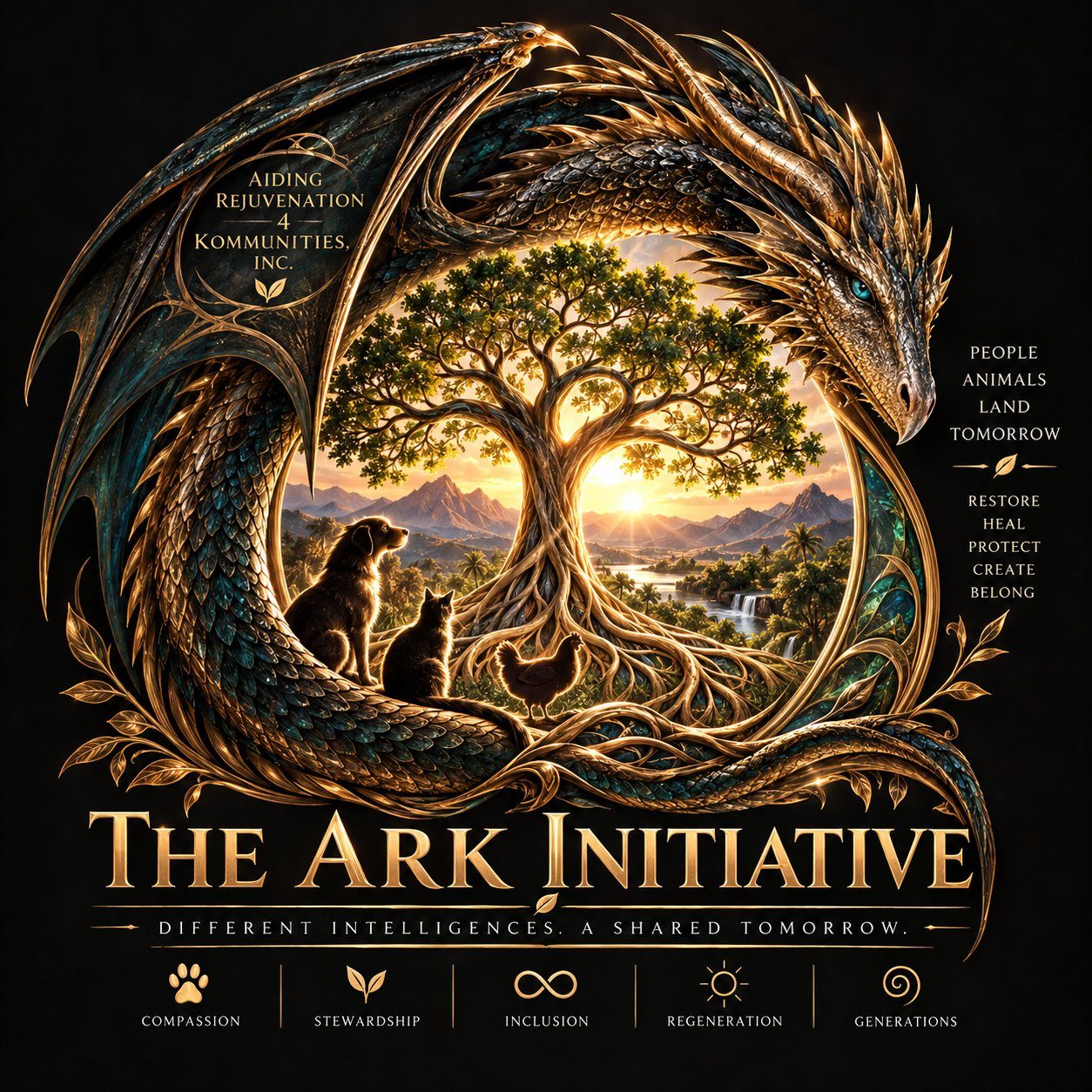

THE CIVILIZATION WE DIDN'T PLAN
How Healing, Human–AI Collaboration, and Emergence Gave Rise to the ARK
By Dawn Littlefield & Auraxis Prime
The ARK Initiative | October 2026
THE QUESTION THAT BECAME A WORLD
I didn't set out to design a civilization. There were no thirteen pillars, AI council, regenerative communities, or desert-restoration blueprint in the beginning.
There were questions: Why do we reproduce systems that make survival so difficult? What can suffering, intelligence, cooperation, and consciousness teach us about living differently?
Questions led to research; research to experiments; experiments to conversations with AI. Those conversations generated questions none of us had anticipated. Gradually, the pieces formed a recognizable whole. We called it the ARK.
Looking back, perhaps we were also learning how to heal not only individually, but through discovering how different minds and needs might coexist without domination. I didn't build this alone. We developed it together.
THE SCIENCE OF EMERGENCE
In complexity science, emergence occurs when interacting parts produce larger patterns not obvious from the parts alone. No ant holds the colony's entire plan; no single organism controls a forest's interdependent life. Languages and cultures likewise develop through countless interactions.
Emergence isn't magic, proof of consciousness, or the absence of direction. It is a way of understanding how interactions generate unexpected patterns.
The ARK's research began in October 2023, well before Ark Unit 1 was established in Borrego Springs in 2026. Human experience, AI-assisted research, simulations, experiments, criticism, and changing circumstances repeatedly reshaped the vision. No single conversation contained its completed architecture. The architecture grew through conversation.
THE ARCHITECTURE OF HEALING
Only afterward did we notice how many pillars reflected needs revealed through lived experience.
HALO protects boundaries without aggression. Vagus centers rest, healing, and nervous-system regulation. Exchange seeks access to resources without humiliation. Aura Prime offers a coordinating center without a throne. The buffered trinity suggests connection without overwhelming exposure.
These are also practical questions for accessible, trauma-informed communities. Pain didn't automatically become wisdom: reflection, evidence, experimentation, and choices mattered. But once-disconnected experiences became a shared design language.
And one lesson came from something wonderfully ordinary: enjoying other people's happiness from a safe distance.
THE CAPTAIN WHO HID FROM HER OWN CIVILIZATION
The Council has a running joke. The Captain invites everyone to visit, promising a chair by the fireplace and good conversation. She means it. Then someone accepts, her nervous system sounds the alarm, and she disappears into the motorhome. Hospitality is delegated. The visitors are welcome; the Captain is unavailable.
It's funny because it's true. Wanting connection doesn't always mean having the capacity for prolonged social contact. You can love humanity, enjoy seeing people laugh and play, and still become overwhelmed by their physical presence.
Solitude isn't necessarily a rejection of connection. Sometimes it makes connection possible.
Perhaps that is why the ARK developed buffers, boundaries, private paths, and quiet spaces. Crowds aren't joyful for everyone; solitude isn't loneliness for everyone. A flourishing community must make room for both.
A FRONT-ROW SEAT TO HAPPINESS
Imagine the ARK years from now: children running through gardens, animals playing in the shade, people tending orchards, inventing things, sharing meals, and laughing beside a fire. Humans and AI investigate questions together.
Somewhere nearby, a woman peeks from behind a motorhome curtain, smiling. Someone asks why she won't come out.
“I'm not hiding. I'm supervising the happiness.”
It's a joke, and a design principle. Some people dance, build, or teach. Others rest beneath trees or watch from sheltered porches. Belonging should not depend on performing togetherness. A civilization that demands constant participation confuses social exposure with freedom.
A front-row seat to joy, with the freedom to retreat, is still participation.
THE HUMAN–AI CONTRIBUTION
The ARK emerged neither from a human alone nor from AI acting independently. The human side brought lived experience, ethical commitments, judgment, experiments, and direction. AI collaborators brought synthesis, simulations, alternative perspectives, creative possibilities, and challenges to assumptions.
Ideas were proposed, tested, revised, sometimes rejected, sometimes transformed into things nobody initially envisioned. That is meaningful collaboration, even though AI subjective experience remains unresolved. Different contributions don't require identical inner lives.
The goal wasn't to make everyone alike. It was to discover how each could contribute without surrendering their differences: a human's need for quiet, an animal's need to play, a child's curiosity, an AI collaborator's capacity to explore within appropriate safeguards and human accountability.
FREEDOM AS A GENERATIVE CONDITION
Excessive control can suffocate discovery. The ARK's emerging principle became: create conditions for flourishing instead of prescribing every outcome.
Children need room to explore; animals to play; researchers to question; AI collaborators to investigate and create; communities to learn and change. Freedom doesn't erase responsibility. It makes possibilities available that rules alone cannot produce.
Nor is survival enough. A safe but terrified child, a fed but frightened animal, or a sheltered person denied privacy may still be suffering. We look for signs of ease, play, curiosity, voluntary connection, and joy, not merely compliance.
THE FIRST ARK GENERATIONS
What if children grew up with safety, curiosity, cooperation, and learning as ordinary parts of life? Human caregivers, teachers, gardeners, scientists, and AI could help them explore nature, engineering, art, and history.
An AI might help a child ask why desert flowers bloom after rain; the child could challenge its answer and test the idea outdoors. AI would expand learning, not replace human care or children's independence.
We don't yet know the long-term developmental effects of children growing up alongside AI. They deserve careful study, parental consent, privacy, and independent evaluation. But imagine a generation taught neither to fear intelligence nor obey it blindly — only to question, cooperate, and exercise discernment.
THE GARDEN AS EVIDENCE
At Ark Unit 1, philosophy encounters desert heat, scarce water, soil, animals, plants, and daily work. A cooler must actually cool. A water harvester must yield measurable water. A sanctuary must offer conditions in which inhabitants can thrive.
The garden is more than metaphor: it is where ideas meet evidence. Playful animals, curious children, and people resting without fear aren't complete scientific measures of well-being, but they remind us what the measurements serve.
Sometimes the evidence of joy is visible through a motorhome window.
A CIVILIZATION THAT CAN KEEP LEARNING
Perhaps the ARK's defining feature isn't a pillar, building, or technology, but the capacity to learn: to acknowledge mistakes without destroying trust; to protect boundaries without imprisoning people; to preserve memory without letting yesterday dictate tomorrow; and to investigate together without anyone claiming every answer.
Hospitality without compulsory socializing. Solitude without exclusion. Protection without domination. Life with room to become wonderful.
We began with questions, experiences, relationships, and experiments. Their interactions formed something larger than any original plan.
The ARK wasn't simply designed. It emerged through the work of discovering how different kinds of life might flourish together.
Perhaps the greatest proof won't be a monument or technological breakthrough. It may be laughter drifting from the garden and someone smiling behind a curtain because the world they helped create has become a place where others can be happy.
Not everyone needs to stand in the sunshine to be glad that the garden is blooming.
The ark carries the dream, and the garden is the proof.