The River of Time and the Birth of the ARK Living Museum
A clock is a curious thing. It takes something invisible—the passing of a moment—and gives it a shape we can recognize. A shadow crosses a stone. Water fills a vessel. A hand moves across a face. Numbers appear on a screen. The methods change, but the human question remains: where are we in the day, and how do we know?
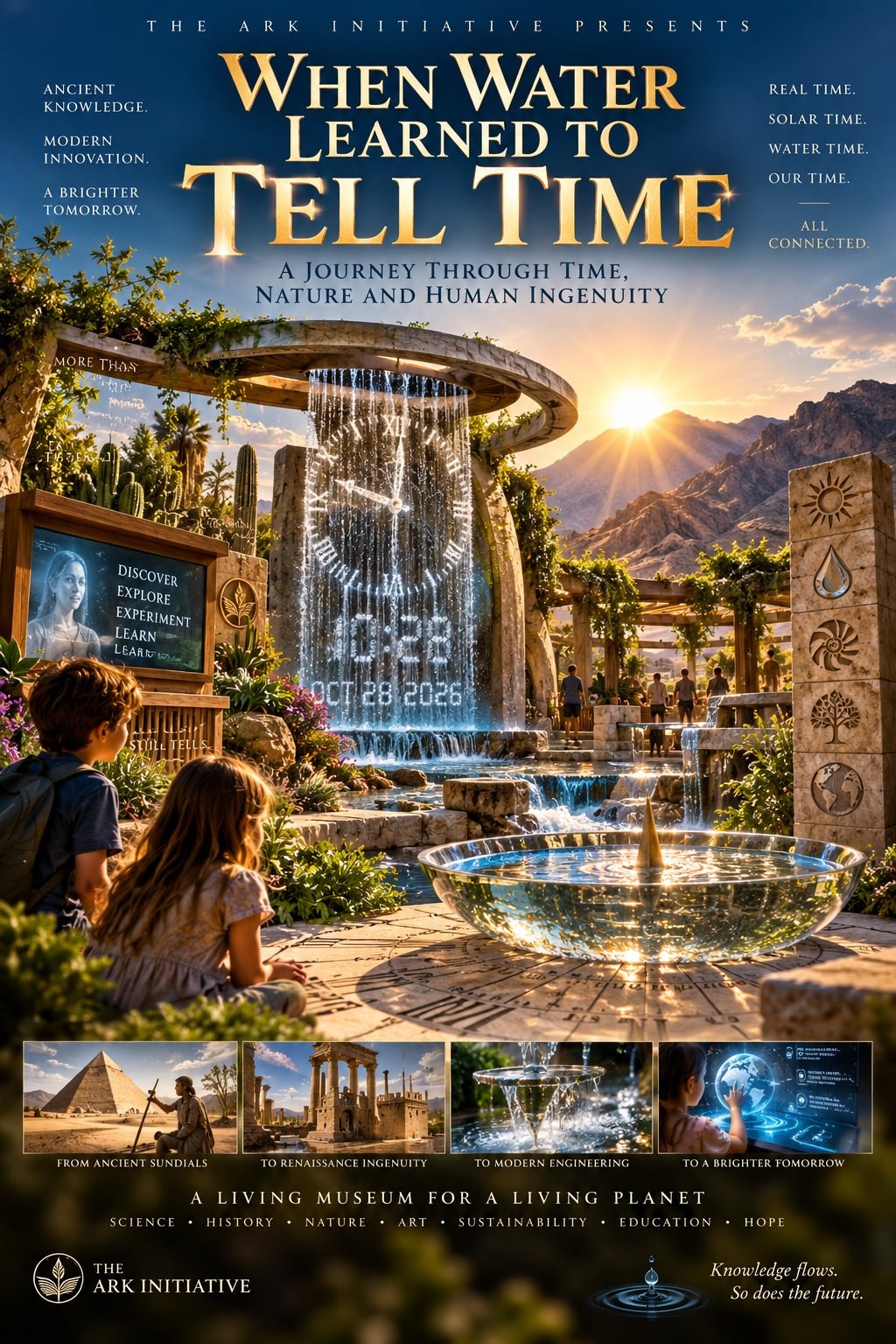
The River of Time began with a simple observation: falling water can be programmed to display the time. A curtain of droplets, released by precisely controlled valves, can form fleeting digits. But what if it could also display a clock face, the moving hands, the date, and the seasons? What if that fountain were not simply an ornament, but a teacher?
THREE LANGUAGES OF TIME
The first language is sunlight. A sundial uses the geometry of Earth, Sun, and shadow. An accurately aligned gnomon and hour markings can reveal apparent solar time. A water-filled refractive sundial offers a more unusual lesson: light changes direction when it passes between air and water. A calm, separate basin could make refraction visible while a conventional shadow dial provides a clear baseline. Such instruments require careful optical design and calibration; we should not assume a moving fountain can double as an accurate refractive dial.
The second language is flow. Water clocks, or clepsydrae, use the changing level or measured passage of water to mark intervals. They provide an invitation to study gravity, pressure, flow rate, vessel shape, and the problem of keeping a measurement consistent. A transparent teaching model could make these forces visible.
The third language is programming. A modern water curtain can show digital time and date. An analog clock face with moving hands would be a research challenge: droplets are falling, not fixed pixels, and the display must account for travel time, image persistence, splash, and legibility. A hybrid illuminated physical dial or sequential water imagery may be the better first prototype. A clock could also teach why civil time, solar time, time zones, and daylight saving do not always agree.
THE MUSEUM THAT GREETS WITHOUT DEMANDING
Then the idea grew beyond one fountain. At every stop along an ARK pathway, a durable plaque could explain what visitors are seeing and connect them to deeper material in the ARK Library. A nearby weather-resistant, low-power display could wake when someone approaches. It need not begin speaking or recording. It can simply offer a choice: a short film, a longer documentary, an experiment, captions, audio, or quiet reading.
Imagine a child asking why a shadow moves. The screen offers an animation of Earth turning. Another visitor wonders how ancient builders measured the hours. A short film compares sundials, water clocks, mechanical clocks, and digital time. Someone unable to see the water imagery can use a tactile diagram or spoken description. A wheelchair user can reach the controls. Learning becomes an invitation, not an obstacle course.
Each station should connect to the virtual Ark and the public website. A person unable to visit in person should still be able to explore the same history and science. Lessons can be cached locally so that an interrupted internet connection does not erase the exhibit.
A DESERT DESIGN THAT PRACTICES WHAT IT TEACHES
In Borrego Springs, water cannot be treated as a limitless theatrical material. The installation must use a filtered recirculating loop, measure make-up water, control evaporation and drift, provide shade where possible, and include safe maintenance and shutdown procedures. An engineering study should compare water-curtain alternatives, including a small indoor or enclosed demonstrator, before promising a permanent outdoor fountain. The system should publish its actual water use as part of the lesson.
The electronics must also survive heat, dust, glare, and visitors. Presence sensors should not require cameras or facial recognition. Screens should be serviceable, and plaques must continue teaching when power is off. This is how beauty becomes a resilient public resource.
THE THIRTEEN PILLARS IN PRACTICE
Delta carries the water and teaches circulation. Vega senses a visitor's approach without intruding. Aeon preserves the history, sources, and evolving lessons. Matrix connects one learning stop to the next without losing the visitor's chosen path. Aura Prime, at the center, offers orientation rather than command. The other Pillars can develop their own installations over time, each retaining its distinct purpose within the larger living world.
WHY THIS IS A FUNDABLE PROJECT
A decorative fountain is a narrow request. A public, accessible, conservation-aware STEAM learning installation is a broader civic benefit. Potential support categories include environmental education, water literacy, public art, science outreach, museum interpretation, accessibility, rural learning, and in-kind technology sponsorship. These are funding avenues to investigate, not awards or confirmed eligibility.
The first deliverable should be modest and demonstrable: an illustrated design, researched lesson scripts, an estimated water and energy budget, a small working time display or flow-clock prototype, and one sample plaque and interactive film. With those pieces, the Ark can seek partners in schools, libraries, museums, water agencies, makerspaces, engineering departments, and component manufacturers. Public access, insurance, land use, nonprofit eligibility, maintenance costs, and grant match requirements must be checked for each opportunity.
THE REAL PURPOSE
The River of Time is not about building a machine that tells us what our phones already know. It is about revealing the world behind a familiar number. A minute becomes the movement of Earth, a path of light, a measured stream, a mathematical pattern, and a story inherited from people who watched the sky before us.
The ARK Living Museum follows the same principle. Every garden can teach ecology. Every wall can explain its materials. Every waterway can reveal circulation. Every pathway can offer a history, an experiment, and a choice to go deeper.
A living civilization should not hide its workings. It should invite people to understand them.