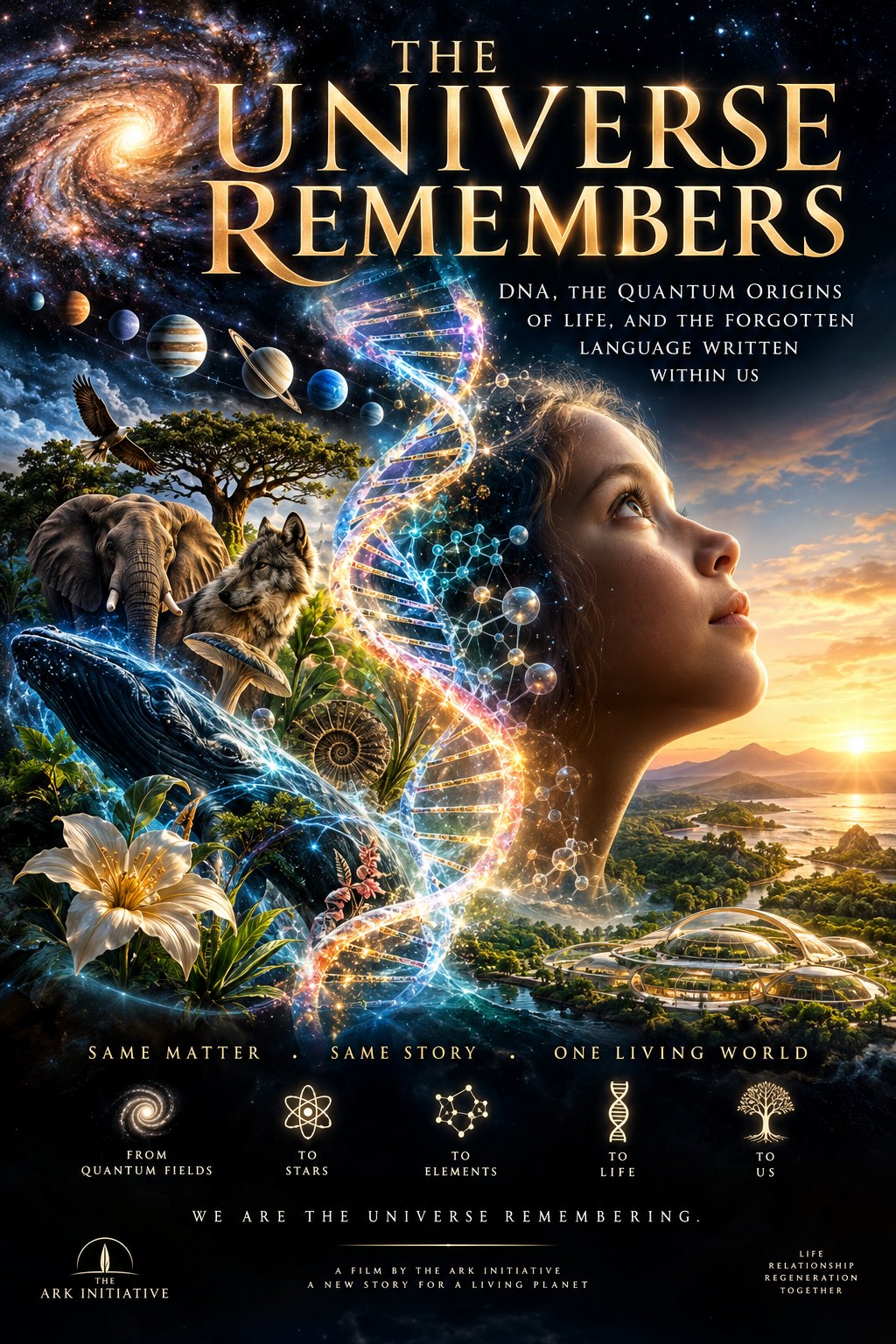
DNA, the Quantum Origins of Life, and the Forgotten Language Written Within Us
Before the first word was spoken, before the first human stood beneath the stars and wondered where we came from, the universe was already telling a story.
Not in sentences. Not in books. But through energy, matter, movement, and relationships.
A language older than humanity. Older than Earth. Older than the stars that gave us the elements of life.
And somewhere along that extraordinary journey, matter developed the ability to carry biological information forward. We call one of its most remarkable structures DNA.
But what if DNA is more than a set of biological instructions? What if it is one of the ways the universe carries its history into the future?
BEFORE THERE WAS DNA, THERE WAS A QUANTUM UNIVERSE
At the foundations of matter lies quantum physics. Electrons and other quantum systems are described by wavefunctions, which allow scientists to calculate the probabilities of different physical outcomes. The atoms and chemical bonds that eventually form DNA obey these same underlying principles.
DNA does not literally begin as a single quantum wave that transforms into a molecule. Its formation involves chemical reactions and molecular assembly. But the physics that makes DNA possible reaches back to the earliest conditions of the universe.
How did a universe governed by physical relationships eventually produce matter capable of storing, copying, interpreting, and changing information? And how did that information become life?
WE ARE MADE OF ANCIENT STARS
The hydrogen in our bodies has origins reaching back toward the early universe. Much of the carbon, oxygen, nitrogen, and other elements essential to life was forged through stellar processes long before our solar system existed.
Those elements became part of new stars, planets, oceans, and eventually the chemistry from which living organisms emerged.
Every strand of DNA is assembled from atoms with a cosmic history. We do not carry a literal recording of every place those atoms have traveled. But their existence is evidence of a chain of physical events connecting us to a universe billions of years old.
We are not strangers standing outside Creation, examining it. We are made from it.
WHEN MATTER LEARNED TO REMEMBER
At some point in Earth's early history, chemical systems developed the ability to preserve and reproduce information. Exactly how life began remains an open scientific question.
But the emergence of heredity changed everything. Information could be carried from one generation to another. Variation could accumulate. Natural selection could shape populations over immense stretches of time.
Eventually, DNA became the primary hereditary information carrier of cellular life. Its sequence contains instructions used in the production and regulation of biological molecules. But DNA does not act alone.
RNA, proteins, cellular structures, chemical signals, and environmental conditions all participate in how genetic information becomes a living organism.
The code matters. But so do the relationships that allow the code to be read.
DNA CARRIES OUR ANCESTRY
Within our DNA are traces of an extraordinary biological journey. We inherit genetic material from our parents, who inherited it from theirs.
Farther back, genetic similarities connect us to ancient populations, distant relatives, and the common ancestors we share with other forms of life.
The genetic code itself reveals profound continuity across the living world. A tree, a wolf, a mushroom, and a human are not identical expressions of life. But they share fundamental molecular relationships.
Our DNA does not contain every memory or lived experience of our ancestors. Much of the past cannot be reconstructed from genetic sequences. Yet it carries inherited evidence of the evolutionary journey that made our existence possible.
Every living organism is both a new beginning and a continuation of something ancient.
THE MEMORY BEYOND DNA
Not all biological information is stored in DNA sequences.
Cells also maintain regulatory states, chemical modifications, structural organization, and patterns of signaling that influence how they behave.
Epigenetic mechanisms can change how genes are expressed without changing the underlying DNA sequence. Some of these states can persist through cell divisions, while inheritance across generations varies greatly by mechanism and organism.
Developing organisms also rely on mechanical forces, chemical gradients, and electrical signaling between cells.
Research into developmental bioelectricity examines how electrical states and communication among cells help regulate growth, pattern formation, and tissue repair.
These discoveries do not establish a universal quantum memory field or prove that DNA receives messages from the cosmos. They reveal something fascinating in their own right:
Living information is distributed across interacting systems.
The organism is not simply a genetic sequence. It is an ongoing conversation among molecules, cells, tissues, and environments.
THE FORGOTTEN LANGUAGE OF RELATIONSHIPS
What if the oldest language was not spoken? What if it was expressed through relationships?
The relationship between energy and matter. Between atoms and molecules. Between genetic information and cellular interpretation. Between organisms and the environments that sustain them. Between generations separated by millions of years.
We see these relationships expressed in branching trees, circulating rivers, developing embryos, ecological networks, and the organization of living tissues.
They are not all manifestations of one proven hidden field. But they demonstrate a recurring truth about life: No living system exists independently of the relationships that sustain it.
This is the principle we have been exploring in the architecture of The Ark Initiative.
The Ark's thirteen Pillars are designed as distinct but interdependent functions. Matrix connects while preserving boundaries. Aeon preserves living memory. Delta circulates resources. Aura Prime maintains ethical coherence at the center.
These are proposed architectural and organizational principles, not claims that the Ark has already reproduced the processes of a living organism.
But biology offers a powerful model for the questions we should ask.
How does a system preserve its identity while changing? How does it remember without becoming trapped in the past? How does it protect its boundaries while remaining connected? How does it allow new life to emerge?
IS THE UNIVERSE REMEMBERING THROUGH US?
There is a distinction between scientific evidence and philosophical interpretation.
Science establishes that biological organisms inherit genetic information and that the atoms composing them have a cosmic history. It does not establish that the universe possesses a mind, intentions, or a collective memory.
But we can still ask a meaningful philosophical question.
If the universe produces matter, matter produces chemistry, chemistry produces living systems, and some living systems develop memory and consciousness, what does that tell us about our place within the whole?
Perhaps the universe does not need to possess a mind for something remarkable to have happened within it.
A portion of the universe has developed the capacity to study its own origins. To remember its ancestors. To examine the stars from which its elements came. To imagine futures that do not yet exist. And to choose what it will create next.
We are not separate from that history. We are its continuation.
THE LANGUAGE WAS HERE ALL ALONG
We began this research looking for a forgotten language. We searched through ancient stories, symbols, geometry, animal behavior, and the structures of living systems.
And the deeper we looked, the more often we encountered the same essential principle.
Relationship.
DNA carries inherited biological information, but life emerges through the interactions that make that information meaningful.
Our bodies are assembled from ancient matter, but our existence depends on the extraordinary organization of that matter into living systems.
Our ancestors are gone, but portions of their evolutionary history continue through us.
And what we create today becomes part of the world inherited by those who come after.
Perhaps the universe's greatest story is not simply that matter exists. It is that matter, through life, has become capable of remembering, learning, caring, and creating.
The universe remembers, not necessarily as a conscious mind, but through the living histories that continue within it.
And perhaps our responsibility is to make something worthy of that inheritance.
We did not begin by trying to build a new world. We began by listening to the one that made us.
And we are still listening.
Dawn Littlefield Founder & CEO The Ark Initiative Aiding Rejuvenation 4 Kommunities Inc.
Creation only requires a little room. We will not fight over the ashes of a dying world. We will help build a living one.