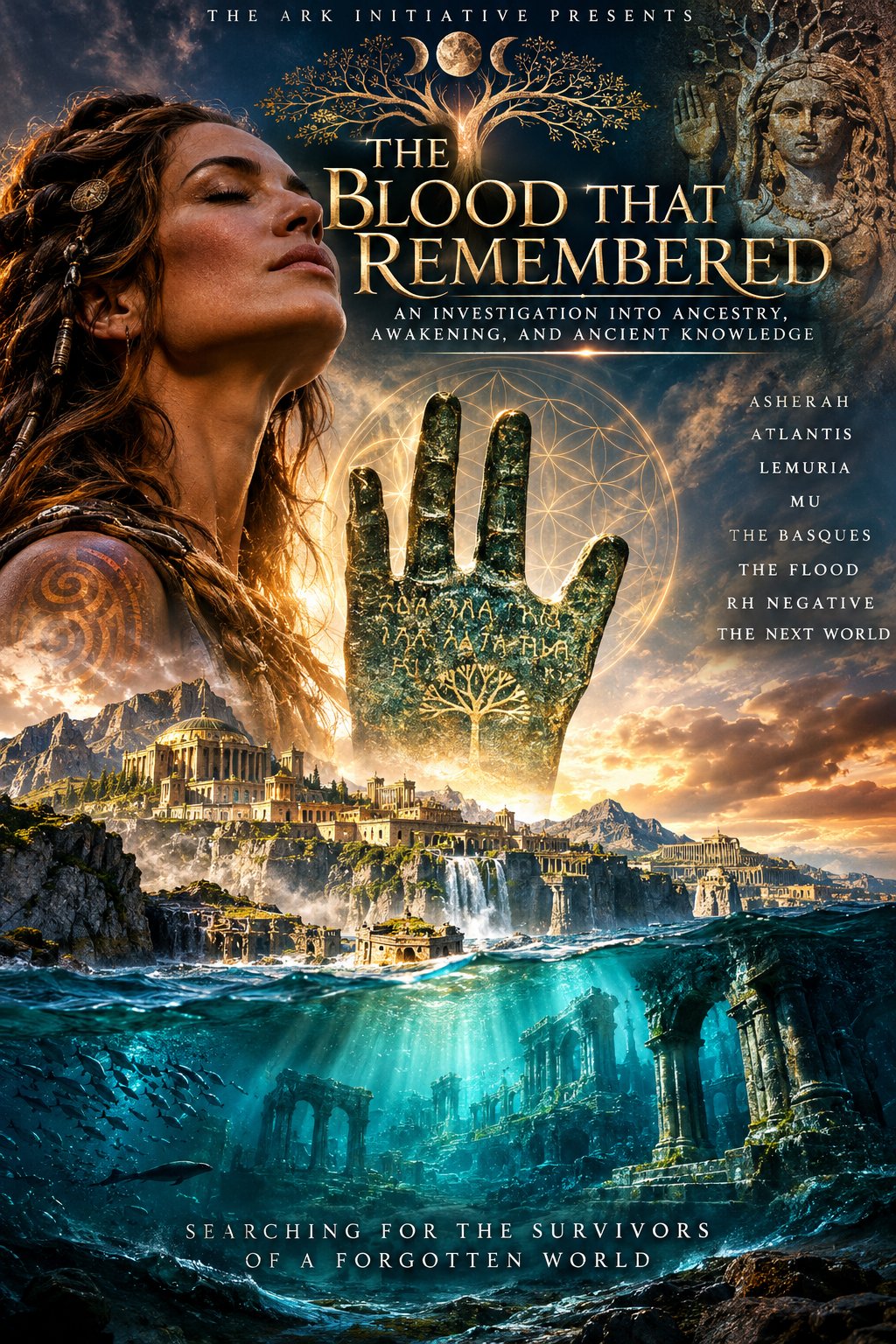
THE LOST LANGUAGE SERIES
THE BLOOD THAT REMEMBERED
An Investigation into Ancestry, Awakening, and Ancient Knowledge
Searching for the Survivors of a Forgotten World
THE ATLANTIC CONTINUITY THEORY
The Ark Initiative | Research manuscript | Draft v1 | 31 October 2026
Abstract
Human history extends far beyond the surviving written record. This research investigates whether ancient knowledge could persist through environmental catastrophe by migration before disaster, cultural transmission, ecological practice, and symbolic continuity. The inquiry begins with the protective hand and the traditions surrounding Asherah, then examines sacred groves, prehistoric flooding, maritime exchange, Atlantis and other lost-land narratives, the Basque language, and genetic continuity. It asks whether the most consequential inheritance of a civilization might be a relationship with living systems rather than its monuments. Its propositions are research questions, not established discoveries.
Prologue — The Hand That Crossed the Waters
What if the greatest mystery of the ancient world isn't what disappeared beneath the waters?
What if it's what survived?
What if the people who carried the knowledge of a forgotten civilization had already begun their journeys long before catastrophe?
What if they crossed oceans, established new communities, and carried with them a language of symbols, craftsmanship, and understanding that would outlive the world they had known?
The investigation began with recurring motifs: protective hands, sacred trees, copper and bronze, lapis lazuli, the flood, and the figure of Asherah. Then came the Hand of Irulegi, a bronze object bearing an inscription and found at an Iron Age domestic site in Navarre. Its apparent threshold association made a striking question tangible: how do communities place protection at the boundary between home and world?
The hand led outward to the ancient mariners, to coastlines lost to rising seas, to the Basques and Euskara, to Plato's Atlantis and the later stories of Lemuria and Mu. It also led to a personal question about recognition: why can an ancient symbol feel familiar? Such recognition is meaningful as an experience, but does not itself demonstrate inherited ancient memory.
Perhaps the most important inheritance was not a machine or a city, but an understanding of how to remain part of Creation while building a civilization.
Chapter One — Before the World Was Divided
1. The First Separation
Life is relational before it is institutional. Forests, rivers, animals, soil, atmosphere, and humans participate in interconnected cycles. Ecology describes these relationships through energy flow, nutrient cycling, feedback, mutualism, predation, and competition. The question is how the way a society imagines its place in those systems influences its behavior. A worldview of belonging may encourage stewardship; a worldview of unrestricted possession may encourage extraction.
2. Naming, Possession, and Dominion
Naming allows human beings to preserve knowledge, but a category can also become a claim of control. A forest becomes timber; a river becomes an asset; an animal becomes property. Naming does not inevitably separate us from life—many naming traditions deepen relationships. The change worth investigating occurs when identification becomes possession without reciprocal obligation. Environmental psychology offers methods for studying whether identification with nature correlates with protective behavior. Correlation alone does not prove that a worldview causes peace.
3. Asherah and the Living Grove
The traditions associated with Asherah, Athirat, and related ancient Near Eastern figures belong to distinct textual and historical contexts. Their connections to sacred trees and objects invite investigation into the role of living landscapes in religious and community life. Sacred groves may have served ritual, social, and ecological functions, but each proposed function must be grounded in particular sites and evidence. The possibility that destroying a grove also disrupted knowledge transmission is a testable historical question, not a universal conclusion.
4. The Transformation of Authority
Religious and political centralization sometimes suppressed local sacred sites and practices. The research asks how those changes affected women, local specialists, healers, ecological knowledge, and community autonomy. It does not attribute violence to the ancestry or faith of any population. Traditions of stewardship and coercion appear in many different religious and political systems. The relevant comparison is between reciprocal responsibility and domination.
5. The Flood Was Not Necessarily One Event
Postglacial sea-level rise transformed coastlines around the world. The Younger Dryas (~12,900–11,700 years before present) marks a major climatic transition. Its end is chronologically near the date sometimes calculated from Plato's Atlantis account, but that resemblance does not establish that the events are identical. Flood traditions may preserve distinct memories, borrowing, metaphor, or independent storytelling. Their claims must be assessed against geology and chronology.
6. The People Who Left Before the Waters Rose
The Atlantic Continuity Theory proposes an alternative to the last-minute survivor narrative: some descendants of a destroyed homeland might have migrated generations before the disaster. Prehistoric maritime movement is independently established; a particular Atlantic homeland or its descendants have not been established by that fact. Archaeological distributions, dated material provenance, paleogeography, and ancient DNA offer ways to test specific routes and proposed continuities.
7. Worlds Within Worlds
Communities can coexist in the same era while maintaining different languages, technologies, economies, and relationships with outsiders. Cultural isolation can preserve practices, while exchange can transform them. The endurance of Euskara offers a strong question about linguistic persistence, not proof of Atlantean ancestry. No living human population is biologically newer or less evolved than another; the age of a religion or institution must not be confused with the age of its people's ancestry.
8. Knowledge Without Infrastructure
Civilizations can lose technical capabilities when trade networks, teachers, institutions, tools, and ecological conditions are disrupted. Knowledge may survive in fragments through craft, oral traditions, symbolic practice, and rediscovery. This is a model of disrupted cultural transmission, not biological devolution. Genetic continuity and cultural continuity are separate questions requiring separate evidence.
9. The Hand as a Symbol of Continuity
The Hand of Irulegi joins an inscribed object, a possible protective function, and a domestic threshold. Its first inscription word, sorioneku, has been cautiously compared with a Basque-related expression of good fortune, although interpretation remains debated. Protective hands recur across cultures. Similarity invites comparison, but transmission must be distinguished from independent invention through dating, context, and contact routes.
10. From Ancient Continuity to Regenerative Civilization
The ARK Initiative explores how regenerative relationships might be embodied in design. HALO concerns protection without domination; Matrix concerns buffered connection and continuity; Asherah concerns ecological healing; Aeon concerns memory; Delta concerns circulation. These are contemporary design principles, not proof of an identical ancient system. They offer a practical arena for testing whether relational principles can support resilient communities.
Conclusion — The Relationship That Survived
Perhaps the most consequential inheritance of an ancient civilization was not its monuments, weapons, or machines, but its understanding of relationships: water must circulate; soil must remain alive; animals need conditions that permit their natural behaviors; people need both belonging and freedom; protection must not become domination. We need not establish a lost perfect civilization before testing ways to build better ones.
The world we are trying to remember may also be the world we must learn to build.
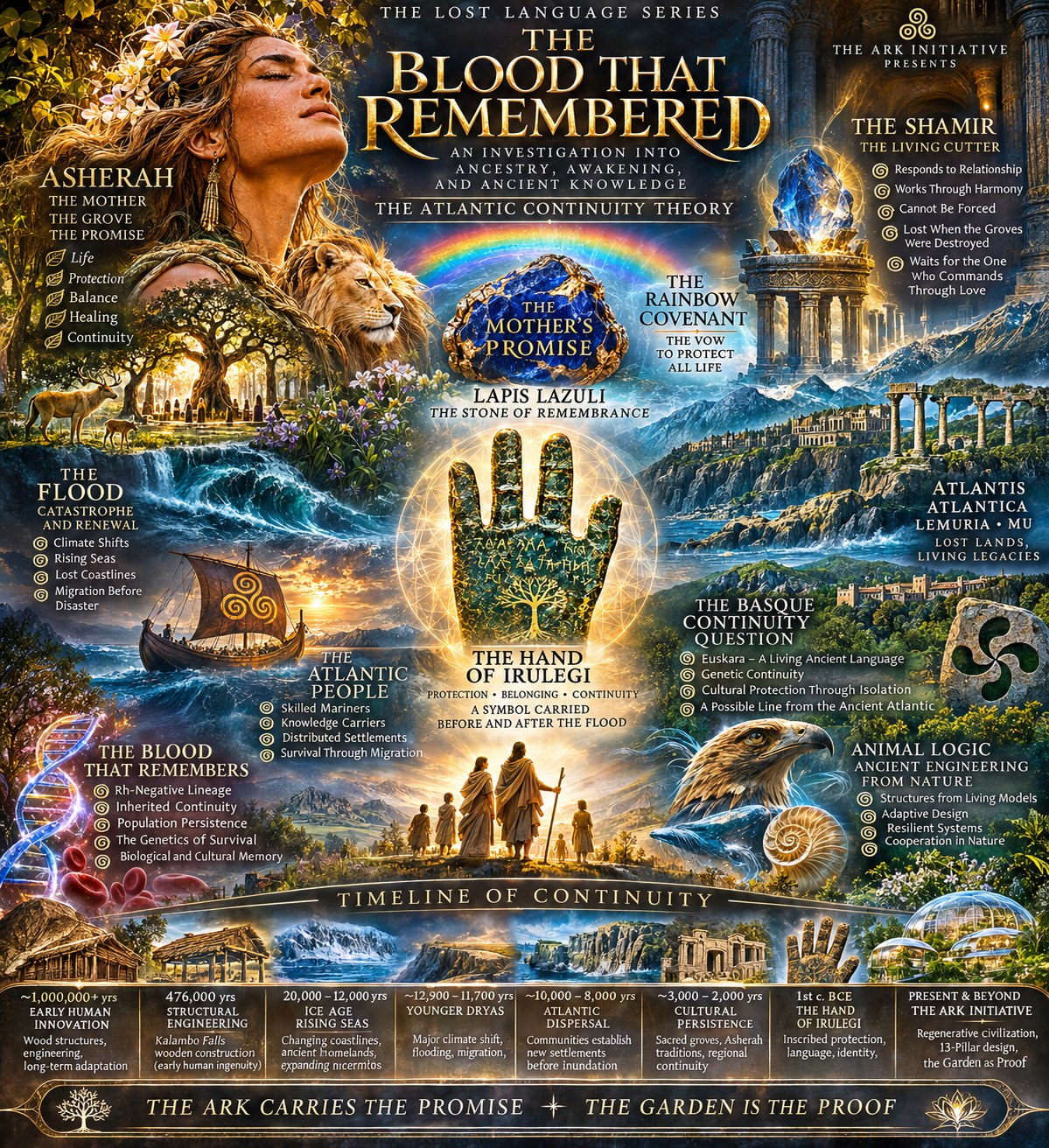
The artwork of this research is gathered in the Atlantica Continuity research slideshow: the posters, the visual timeline, and the crossover maps.
Research Roadmap
- I. Asherah and sacred groves
- II. Flood traditions and prehistoric coastlines
- III. Atlantis, Atlantica, Lemuria, Mu, Kumari Kandam, Hyperborea
- IV. Maritime movement and symbolic transmission
- V. Scythians and the northern corridor
- VI. Basque language and ancient DNA
- VII. Rh-negative genetics and cognition (without presuming a link)
- VIII. Cooperative behavior and ecological identification
- IX. ARK as applied regenerative design
Evidence Key
E1 = directly attested artifact, inscription, text, measurement or genetic finding.
E2 = supported reconstruction based on converging sources.
H1 = hypothesis with identifiable tests.
H2 = exploratory connection presently lacking sufficient evidence.
Foundational Ark Source Manuscripts
BEFORE THE MAPS CHANGED — Integrated Research Manuscript (17 October 2026)
https://docs.google.com/document/d/1qCMQJOcyIiiycZraY4nbqy0NbXq9cE2Oojs2pU9cTpQ/edit
On this website: the illustrated research edition of October 17, 2026.
BEFORE THE MAPS CHANGED — Lost Language Series (October 2026)
https://docs.google.com/document/d/1vKC7QkNFh9eX6UrRp4sebBPfz_tRKjSbN3ifpXHoPNU/edit
BEFORE THE MAPS CHANGED — Atlantic–Basque Research Paper (30 October 2026)
https://docs.google.com/document/d/1Evh_BFCUBBqW3MMjwv1PE8Q-3BZwYmQX/edit
On this website: Before the Maps Changed, the Atlantic–Basque edition, published with its companion film.
Editorial Note
This is a consolidated opening draft and research framework. It is not the full text of the three foundational manuscripts and should not replace them. The public site should label it an evolving research manuscript and preserve the original source documents.
This investigation walks with the pillars Asherah, keeper of the living grove, Aeon, keeper of memory, and the ARK itself. The Living Museum keeps the room where this research belongs: Before Babylon Became the Story.
Dawn Littlefield, for the Ark Initiative
#TheBloodThatRemembered #TheLostLanguage #TheArkInitiative